The Cool Side of Laser Medicine
By Jill Kato, UC Irvine Beall Applied Innovation
Tom Milner, former UC Irvine professor of surgery and biomedical engineering, makes revolutionizing laser medicine sound easy.
“It was a pretty smooth path. The first time we tried it, we thought, ‘Hey, this looks like it’s going to work,’” he says about his work on lasers thirty years ago.
Milner, who recently served as the director of the Beckman Laser Institute, was a vital part of the team that invented the Dynamical Cooling Device (DCD), a medical device that sprays a cooling agent onto the skin before a laser pulse to enhance effectiveness and lessen pain.
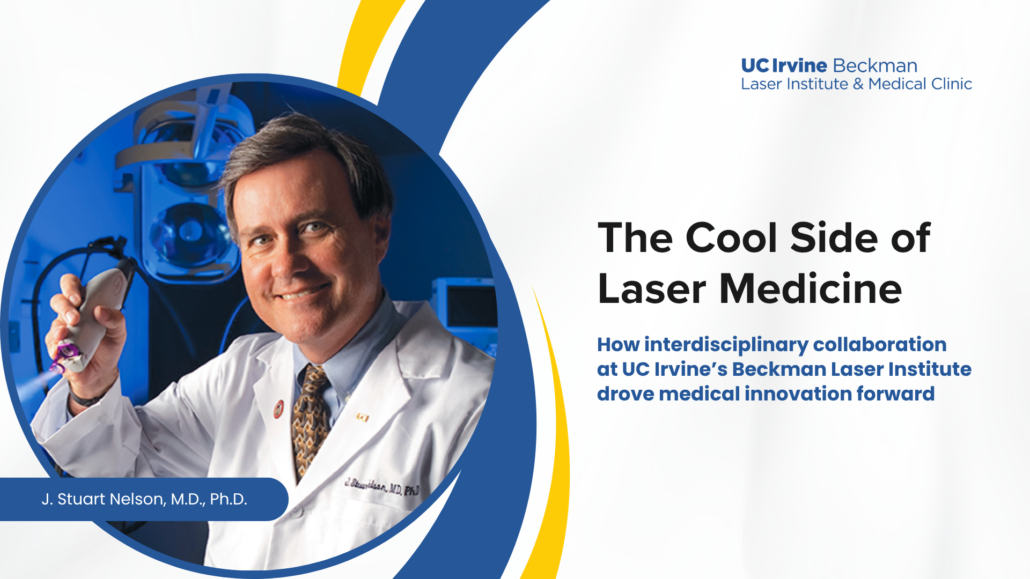
The DCD developed from an epiphany, Milner’s colleague, distinguished professor of surgery and biomedical engineering J. Stuart Nelson, had while watching a player get hit by a “stinger” during a baseball game. He noticed how after the hit, a trainer would spray a cooling agent on the player’s injury to numb the pain.
Milner’s research team was in the midst of applying for grants from the National Institutes of Health (NIH) when Nelson wondered whether a cooling agent could be used in combination with lasers to cool and numb the skin. Over dinner, Nelson discussed his idea with Milner and visiting engineer Lars Svaasand, and the three agreed the idea had legs.
After spit-balling their ideas over the weekend, Milner went out to buy a valve while Svaasand and a student went down to the local Pep Boys to purchase R-134a, a refrigerant commonly used in automotive air conditioning systems. In the lab, they connected the refrigerant to the valve and controlled the valve with a delay generator that created a pulse to trigger the spray. In a short amount of time, their first prototype was built. The result: a breakthrough device that has since treated millions of patients and shaped the future of laser medicine.
Cold Comfort
Before the invention of epidermal cooling, the effectiveness of laser treatment was limited by the laser’s intensity. The heat caused patients pain, possible scarring, and pigmentation changes in the skin. Plus, the treatment wasn’t effective on patients with darker skin tones, since melanin in the epidermis, or top layer of skin, limited the amount of light that could reach the blood vessels that physicians were trying to treat.
When Milner first arrived at UCI in 1992, he was a research fellow joining Nelson’s team. Nelson, who is also the current medical director at the Beckman Laser Institute, was trying to come up with a more effective way to treat port-wine stains, hemangiomas, and other vascular malformations.
“We understood from the physics point of view that it was a question of how to make the skin really cold in a short amount of time,” Milner says.
The team’s challenge was to find a way to protect the outer skin while allowing the laser to penetrate deeper to the blood vessels that created these vascular abnormalities. They knew they needed to cool the skin; it was just a matter of how.
Before coming up with the cooling spray idea, the team’s original plan was to bring a cooled window onto the skin before quickly removing it.
“To me, this seemed a lot harder to build than spraying a liquid on the skin with a valve. Since I was the person who had to execute the solution, I preferred the new idea,” Milner says.
A Big Step Forward
The DCD works by delivering a quick burst of a cryogen or cooling agent, onto the skin immediately before, and often after, a laser pulse. The cryogen evaporates and the laser is triggered to target blood vessels in the dermis (the thick part of the skin under the epidermis). The technology is then incorporated into a handheld laser device that is used by a physician.
Once cooling was implemented to protect the skin’s surface, higher energy levels could be used to produce greater effectiveness. The technology also expanded treatment to patients of all skin types by mitigating the blocking effects of melanin. It also reduced patient discomfort by minimizing injury to the skin.
Dermatology chair Kristen Kelly was a research fellow at the time and worked with Nelson on studies investigating the DCD’s early uses.
“The DCD greatly advanced laser skin surgery. We’re able to provide treatment to a wider range of patients. It made the treatments less uncomfortable, and it helped to increase our efficacy. It really was a big step forward,” she says.
Cool Collaborators
Creating the device turned out to be the easy part. While the physical construction of the DCD presented minimal challenges, its complexity lay in comprehending its interaction with human skin. This is where Milner and his colleagues spent most of their time. They needed to measure the temperature of the skin as it cooled and the temperature of the skin when the laser was fired. They had to ensure their measurements were mathematically predictable and confirm their theoretical understanding of its behavior.
Click here to read full article on the UC Irvine Beall Applied Innovation website.

Author: Gabrielle Comfort