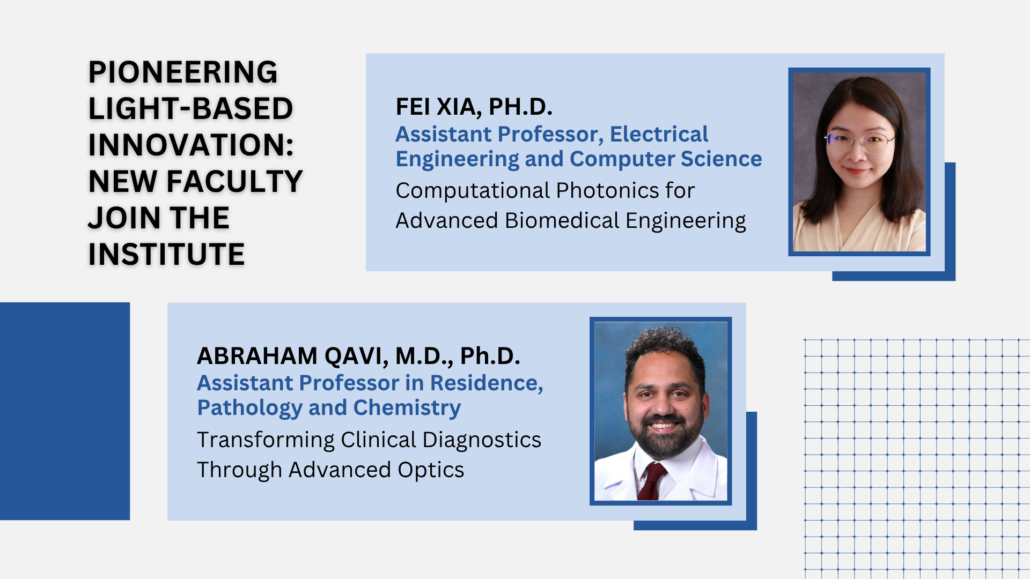
Pioneering Light-Based Innovation: New Faculty Join the Institute
Two distinguished researchers bring cutting-edge expertise in optical diagnostics and computational imaging to advance biomedical applications
UC Irvine Beckman Laser Institute & Medical Clinic welcomes two talented new faculty members whose groundbreaking research in optical technologies promises to revolutionize both clinical diagnostics and neuroscience imaging. Drs. Abraham Qavi and Fei Xia join the institute’s renowned interdisciplinary community, bringing complementary expertise that bridges science, engineering, and medicine.
ABRAHAM QAVI: TRANSFORMING CLINICAL DIAGNOSTICS THROUGH ADVANCED OPTICS
Dr. Abraham Qavi joins the Institute as Assistant Professor in Residence of Pathology and Chemistry, bringing a unique combination of clinical expertise and pioneering research in optical diagnostics. As a board-certified pathologist, Dr. Qavi currently serves multiple leadership roles at UC Irvine Medical Center, including Director of Point of Care Testing, Director of Innovative Laboratory Diagnostics, and Associate Director of Clinical Chemistry.
Revolutionary Diagnostic Technologies
Dr. Qavi’s research program leverages sophisticated optical technologies to address critical gaps in clinical diagnostics. His laboratory specializes in photonic resonators and plasmonic-enhanced sensors—advanced techniques that enable precise control and manipulation of light to dramatically improve diagnostic sensitivity and speed.
“Dr. Qavi’s work represents the future of diagnostic medicine,” states Dr. Bernard Choi, Institute Interim Director. “By harnessing the intrinsic properties of light, his research enables ultrasensitive detection capabilities that could transform how we diagnose and monitor disease.”
Dr. Qavi’s research focuses on two primary technological platforms:
Photonic Resonators: These exquisitely sensitive optical devices exploit light confinement principles to achieve unprecedented detection limits. By trapping light in microscopic cavities, photonic resonators can detect minute changes in their optical environment when target molecules bind to their surfaces. This enables detection of viral particles, proteins, or other biomarkers at concentrations far below what conventional tests can achieve.
Plasmonic Enhancement: Dr. Qavi utilizes the unique optical properties of metallic nanoparticles, particularly gold nanostructures, which can concentrate light into extremely small volumes and amplify optical signals. When light interacts with these specially designed nanoparticles, it creates intense electromagnetic fields that dramatically enhance the detection of nearby molecules.
Clinical Applications and Global Impact
Dr. Qavi’s studies have demonstrated efficacy in rapid viral detection, including filoviruses, such as Ebola, and coronaviruses. His platforms can potentially reduce diagnostic time, while maintaining or exceeding the accuracy of traditional laboratory methods.
This potential extends beyond modern healthcare systems. The low-cost, high-throughput nature of plasmonic sensors makes them particularly valuable for addressing neglected tropical diseases in resource-limited settings, where rapid, accurate diagnosis can be lifesaving.
Dr. Qavi’s research areas include ultrasensitive pathogen detection using photonic resonators, point-of-care diagnostic platforms for global health applications, integration of advanced optics with clinical laboratory workflows and the development of laboratory-developed tests (LDTs) for personalized medicine.
Clinical Foundation
Dr. Qavi earned his medical degree from the University of Illinois College of Medicine in Chicago and completed his residency in clinical pathology at Washington University School of Medicine and Barnes-Jewish Hospital in St. Louis. This strong clinical foundation informs his research approach, ensuring that technological innovations address real-world medical needs.
Click here or visit https://bli.uci.edu/abraham-qavi/ to learn more about Dr. Qavi.
FEI XIA: COMPUTATIONAL PHOTONICS FOR ADVANCED BIOMEDICAL IMAGING
Dr. Fei Xia, Assistant Professor of Electrical Engineering and Computer Science, brings pioneering expertise at the intersection of optics, computation, and neuroscience. Her research centers on developing revolutionary optical systems that image, sense, and process biomedical information through groundbreaking light-based technologies.
Dr. Xia’s research centers on two approaches:
Advanced Optical Systems: Dr. Xia develops sophisticated imaging platforms that can capture biological information across multiple spatial and temporal scales simultaneously. These systems often incorporate adaptive optics, multi-modal detection, and real-time feedback control to optimize image quality for specific applications.
Computational Enhancement: Her laboratory develops machine learning algorithms and signal processing techniques specifically designed to extract maximum information from optical measurements. These computational approaches can reveal patterns and structures that would be invisible to conventional analysis methods.
Precision Imaging for Neuroscience
Dr. Xia’s research program focuses on enhancing imaging precision across spatial (seeing smaller structures) and temporal dimensions (capturing faster processes) to unlock new possibilities in biomedical imaging. Her laboratory is particularly dedicated to brain imaging, recognizing the brain’s critical role as both a regulator of health and the source of human intelligence.
Dr. Xia’s current applications include high-resolution imaging of neural networks in living tissue, real-time monitoring of brain activity during cognitive tasks, early detection of neurodegenerative diseases, and the development of precision tools for neurosurgical planning.
“Through the strategic co-design of hardware and software solutions, Dr. Xia addresses complex biomedical challenges and advances our understanding of living biological systems,” states Dr. Choi. “Her work drives the development of more precise diagnostic tools and discovery platforms that advance both neuroscience research and neurological medicine.”
Global Research Perspective
Dr. Xia’s contributions have earned multiple prestigious awards, including the 2024 Rising Star in Light Award and 2023 Optica Foundation Challenge Award, recognizing her as a leader in the next generation of optical scientists.
Dr. Xia brings a strong international research background, having completed her Ph.D. at Cornell University and postdoctoral research at École Normale Supérieure (ENS) in Paris, France. Her diverse educational experience across three continents – undergraduate studies in China, doctoral work in the USA, and postdoctoral research in France – provides a unique global perspective.
Click here or visit https://bli.uci.edu/fei-xia/ to learn more about Dr. Xia.
LOOKING FORWARD
Drs. Qavi and Xia’s work promises to advance the frontiers of optical technologies in biomedicine. From revolutionizing point-of-care diagnostics to unlocking new insights into brain function, their research represents the cutting-edge of light-based innovation to impact human health.

Author: Gabrielle Comfort