Beckman Laser Institute
  • About Us
      • About Us
      • Mission & Vision
      • Message From the Founding Director
      • History
      • By the Numbers
      • Employment
      • News
  • Medical Clinic
      • Medical Clinic
      • Conditions & Treatments
      • Why Choose Us
      • Clinical Research Protocols
      • Our Physicians
      • Our Clinic Team
  • Research
      • Research
    • Core Research
      • Modeling & Computation
      • Multimodal Endoscopy
      • Microscopy & Microbeams
      • Diffuse Optical Imaging
      • Laser Therapy
    • Research Programs
      • COVID-19 RESEARCH
      • Medical Applications
      • Laser Microbeam Program (LAMP)
      • Wearable Sensors
    • Shared Resources
      • Shared UCI Access Resources
  • Education & Outreach
      • Education & Outreach
      • Prospective Students
      • Access to Careers in Engineering and Sciences (ACES)
      • Publications
      • Mechanical Ventilation Amid COVID
      • Leaders in Light
      • Multiscale Biophotonics Training Program
      • Events
      • LASER Magazine
      • Course Catalog
  • Industry
      • Industry
      • Photonic Incubator
      • Technology Transfer
      • Patents
      • Convergence Optical Sciences Initiative (COSI)
      • Corporate Partners
      • Advisory Board
  • People
      • People
      • Our Faculty
      • Our Founders
      • Directory
      • Our Research Team
      • Our Research Management Team
      • Our Administrative Team
  • Giving
      • Giving
      • Donate Online
  • How to Give
  • Ways to Give
  • Click to open the search input field Click to open the search input field Search
  • Menu Menu
Blog - Latest News

Scientists Testing New LASIK-Like System That Doesn’t Use a Laser on Eyeball

August 19, 2025/ News /by Gabrielle Comfort
Aug 19, 3:50 PM EDT / by Victor Tangermann
“The Whole Effect Was Discovered by Accident.”

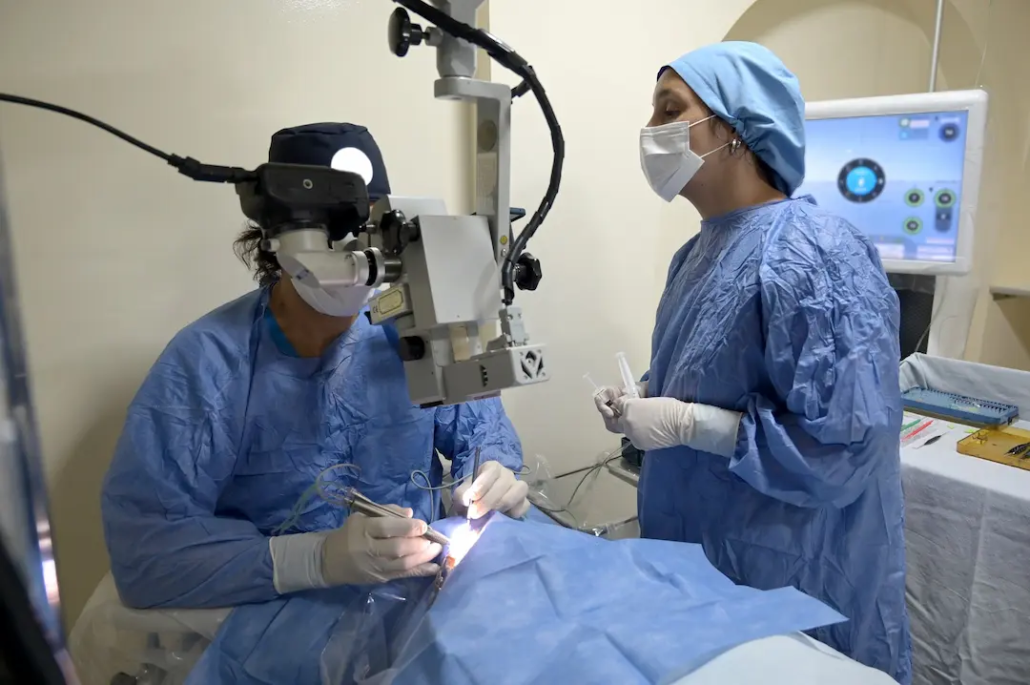
Researchers have come up with a potentially groundbreaking — and entirely laser-free — alternative to LASIK, a popular surgical procedure that uses high-power lasers to reshape the cornea to correct vision problems.

During a meeting of the American Chemical Society, a team of scientists led by Occidental College chemistry professor Michael Hill showed off a new approach, called “electromechanical reshaping” (EMR), that uses small jolts of electricity and a molded platinum “contact lens” to reshape the cornea.

While we’re still many years away from being able to tell if the new technique will be a viable alternative to LASIK, there are reasons to be optimistic. LASIK surgery, which has been around for decades, can have rare but negative side effects including dry eyes or — in extreme cases — vision loss or infection.

EMR could greatly simplify the process without relying on invasive surgery, the scientists say, and potentially lower costs as well.

“The whole effect was discovered by accident,” said team member and University of California, Irvine, professor Brian Wong in a statement. “I was looking at living tissues as moldable materials and discovered this whole process of chemical modification.”

Research has shown that adjusting the pH of collagen-containing tissues in the body, such as corneas, allows them to become temporarily malleable.

Hill and his colleagues previously demonstrated that EMR can be used to alter the shape of rabbit ears, for example, and even scar tissues in pigs.

In experiments involving rabbits, the team used a platinum “contact lens” in the shape of a corrected cornea as a way to generate precise pH changes in the animal’s tissues.

Roughly a minute later, around the time it takes to perform LASIK, the rabbit’s cornea conformed to the contact lens — but with fewer steps and no incisions, according to the researchers.

The team successfully improved the shape of eyeballs, which were treated as if they had myopia, or nearsightedness, in ten out of 12 rabbit eyeballs.

The team suggests the new technique could reverse common reasons why patients choose to undergo LASIK, including nearsightedness.

It could even reverse chemical-caused cloudiness, which conventionally can only be treated through a complete corneal transplant.

Despite promising results — for all but two bunnies, at least — we’re still many years away from determining if EMR can become a viable alternative to LASIK.

In the statement, Wong explained that he and his colleagues are gearing up for a “long march through animal studies that are detailed and precise.”

The team is also struggling with finding the required scientific funding.

“There’s a long road between what we’ve done and the clinic,” said Hill in the statement. “But, if we get there, this technique is widely applicable, vastly cheaper and potentially even reversible.”

Click here to read full article on the Neoscope website.

Gabrielle Comfort

Author: Gabrielle Comfort

Share this entry
  • Share on Facebook
  • Share on X
  • Share on LinkedIn
  • Share on Reddit
  • Share by Mail
https://bli.uci.edu/wp-content/uploads/2025/08/lasik-like-system-laser-eyeball-1-1.webp 718 1080 Gabrielle Comfort https://www.bli.uci.edu/wp-content/uploads/2017/09/white_transparent-1.png Gabrielle Comfort2025-08-19 11:57:322025-08-21 13:50:10Scientists Testing New LASIK-Like System That Doesn’t Use a Laser on Eyeball
Search Search

Categories

  • News
FOLLOW US ON SOCIAL MEDIA
  • Link to X_icon
  • Link to Facebook
  • Link to LinkedIn
  • Link to Youtube
  • Link to Instagram
  • Support BLIMC❤️
  • Contact US
  • For Staff
Link to: Laser-free vision correction uses electrical current to reshape eye Link to: Laser-free vision correction uses electrical current to reshape eye Laser-free vision correction uses electrical current to reshape eye Link to: Laser-free vision correction uses electrical current to reshape eye Link to: Laser-free vision correction uses electrical current to reshape eye Laser-free vision correction uses electrical current to reshape eye
Scroll to top Scroll to top Scroll to top
Loading...

Insert/edit link

Enter the destination URL

Or link to existing content

    No search term specified. Showing recent items. Search or use up and down arrow keys to select an item.